
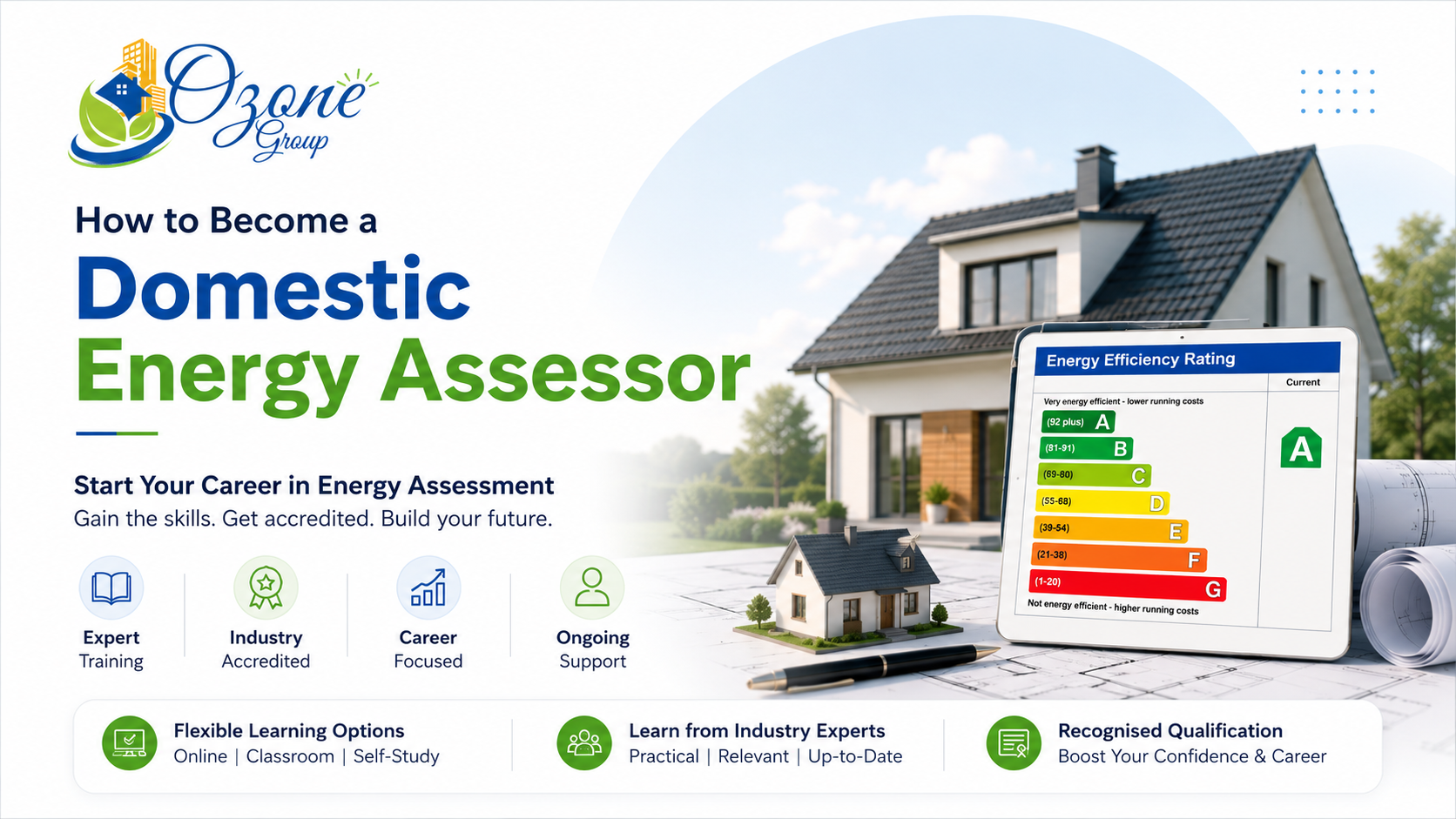
How to Become a Domestic Energy Assessor
A complete career guide to qualifying and working as a Domestic Energy Assessor in the UK.
A Domestic Energy Assessor (DEA) is a qualified professional who inspects homes and produces Energy Performance Certificates (EPCs). EPCs are a legal requirement whenever a home is built, sold or rented in England, Wales and Northern Ireland — which makes DEA one of the most in-demand energy assessment careers in the UK.
This guide walks you through exactly how to qualify: from choosing a City & Guilds-approved course, through building your portfolio, joining a government-approved accreditation scheme and starting to earn as a self-employed or employed assessor.
What does a Domestic Energy Assessor do?
A DEA carries out non-invasive surveys of dwellings and uses approved software (RdSAP) to generate an EPC. The EPC rates the home from A to G and recommends improvements. Typical day-to-day work includes:
- Booking and visiting properties across a local area.
- Measuring rooms, recording construction, insulation, heating, glazing and lighting.
- Taking photographic evidence for the audit trail.
- Producing and lodging the EPC on the national register within the required timescale.
- Advising homeowners, landlords, estate agents and solicitors on the report.
The 5 steps to becoming a DEA
Step 1 — Check the entry requirements
There are no formal academic entry requirements. You need to be over 18, have good written English, be comfortable with basic IT and be physically able to inspect properties. A background in construction, surveying, estate agency, energy or property is helpful but not required — most learners come from other careers.
Step 2 — Complete a City & Guilds-approved DEA training course
The recognised qualification is the Level 3 Certificate in Domestic Energy Assessment. Choose a training provider that is a City & Guilds-approved centre, so your certificate is accepted by every UK accreditation scheme. At Ozone Group Training, the course is available as classroom training, live online sessions and guided online learning, so you can fit study around work.
Step 3 — Build and submit your portfolio
Qualification is competence-based, not assignments-only. You must complete a portfolio of 5 real domestic property assessments covering different property ages, construction types and heating systems. Your tutor reviews each EPC and RdSAP input for accuracy before submitting the portfolio to City & Guilds for certification. Ozone Group will provide you with 2 case studies, and you will only need to source 3. These can be your own or friends' and family's properties.
Step 4 — Join an accreditation scheme
Once certified, you must join a government-approved accreditation scheme before you can lodge EPCs. Well-known schemes include Elmhurst Energy, Quidos and ECMK. Membership includes access to the EPC register, professional indemnity insurance options and continuing professional development (CPD).
Step 5 — Start working as a DEA
You can now work self-employed, take on subcontract work from EPC panels and estate agents, or join a surveying or energy company as an employed assessor. Many new DEAs start part-time alongside their existing job and scale up as their local reputation grows.
How long does it take?
Most learners qualify in 1-3 weeks. The taught element can be completed in as little as 5 days in the classroom or 2–3 weeks part-time online. The portfolio typically takes another 1- 3 weeks, depending on how quickly you can arrange three suitable properties.
How much does a DEA earn?
Fees vary by region and property type. As a guide, self-employed DEAs charge £45–£120 per EPC and complete 2–6 assessments per day. Full-time DEAs typically earn £45,000–£55,000 per year, with higher earnings available in London and the South East or by branching into commercial EPCs, retrofit assessment and Retrofit Coordination.
Where to go next
Ready to start? Explore the Domestic Energy Assessor course or view the full course catalogue to see delivery options and upcoming dates. Many learners also progress to the Non-Domestic (Commercial) Energy Assessor and Retrofit Assessor qualifications to broaden their services.
If you have questions about entry, funding or timescales, contact our team — we are a City & Guilds approved centre and support every learner through certification.
Start your DEA career
Enrol on our City & Guilds approved Domestic Energy Assessor course — classroom, live online or guided online learning.
View DEA course