
Commercial Energy Assessor (NDEA) Course Syllabus | Level 3 & 4 Modules & Assessments
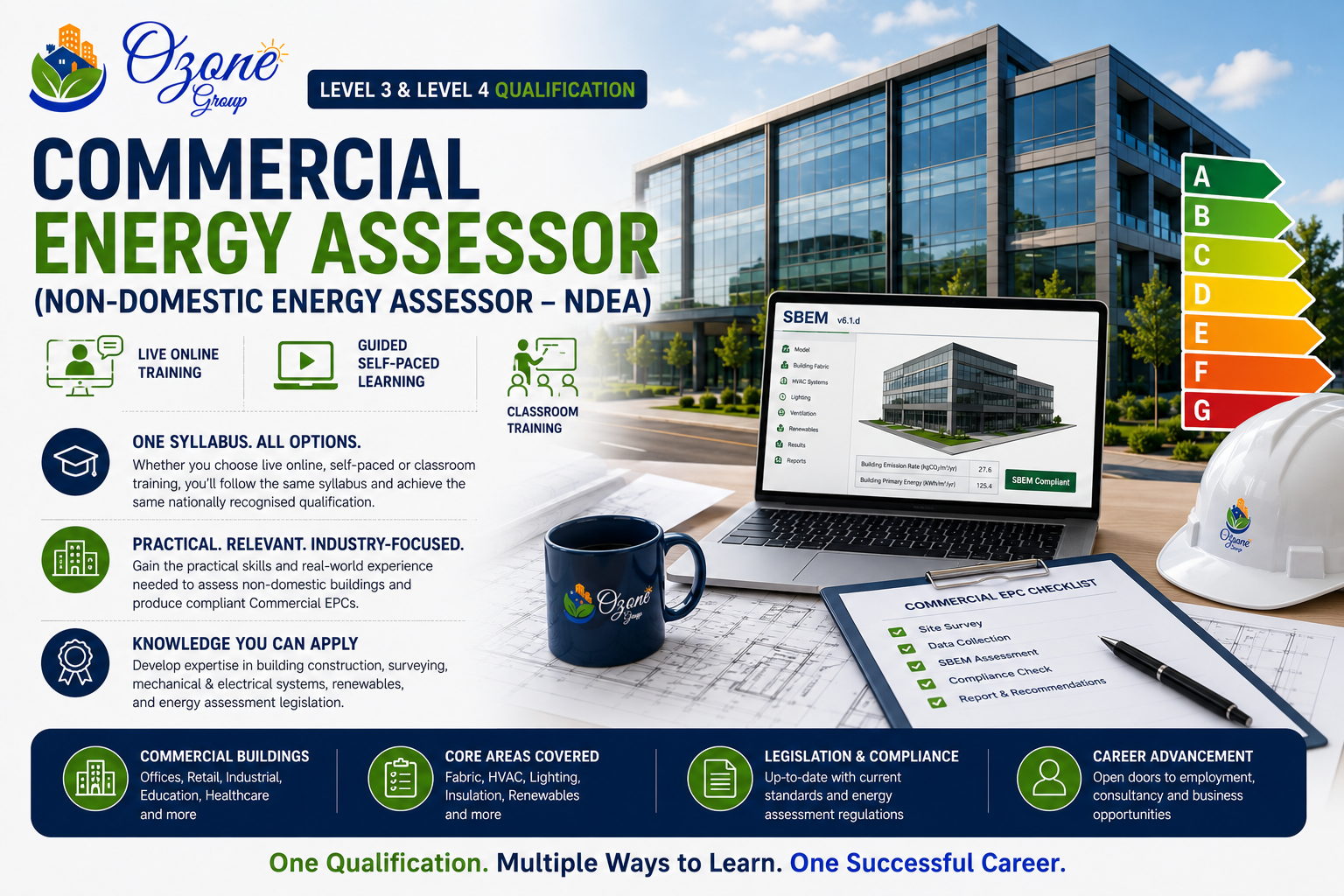
View the modules and learning outcomes included in the Level 3 & Level 4 Commercial Energy Assessor (Non-Domestic Energy Assessor – NDEA) qualification. This syllabus applies to all Ozone Group Commercial Energy Assessor delivery options, including live online, guided self-paced learning, and classroom training.
The Level 3 & Level 4 Commercial Energy Assessor (NDEA) qualification provides the knowledge, practical skills and industry experience required to assess non-domestic buildings and produce compliant Commercial Energy Performance Certificates (Commercial EPCs) using approved SBEM software.
Throughout the course, you'll develop a comprehensive understanding of commercial building construction, surveying techniques, heating and ventilation systems, lighting, insulation, renewable technologies and current energy assessment legislation. Regardless of which learning option you choose, you'll follow the same qualification syllabus and work towards the same nationally recognised qualification.
Modules in the course
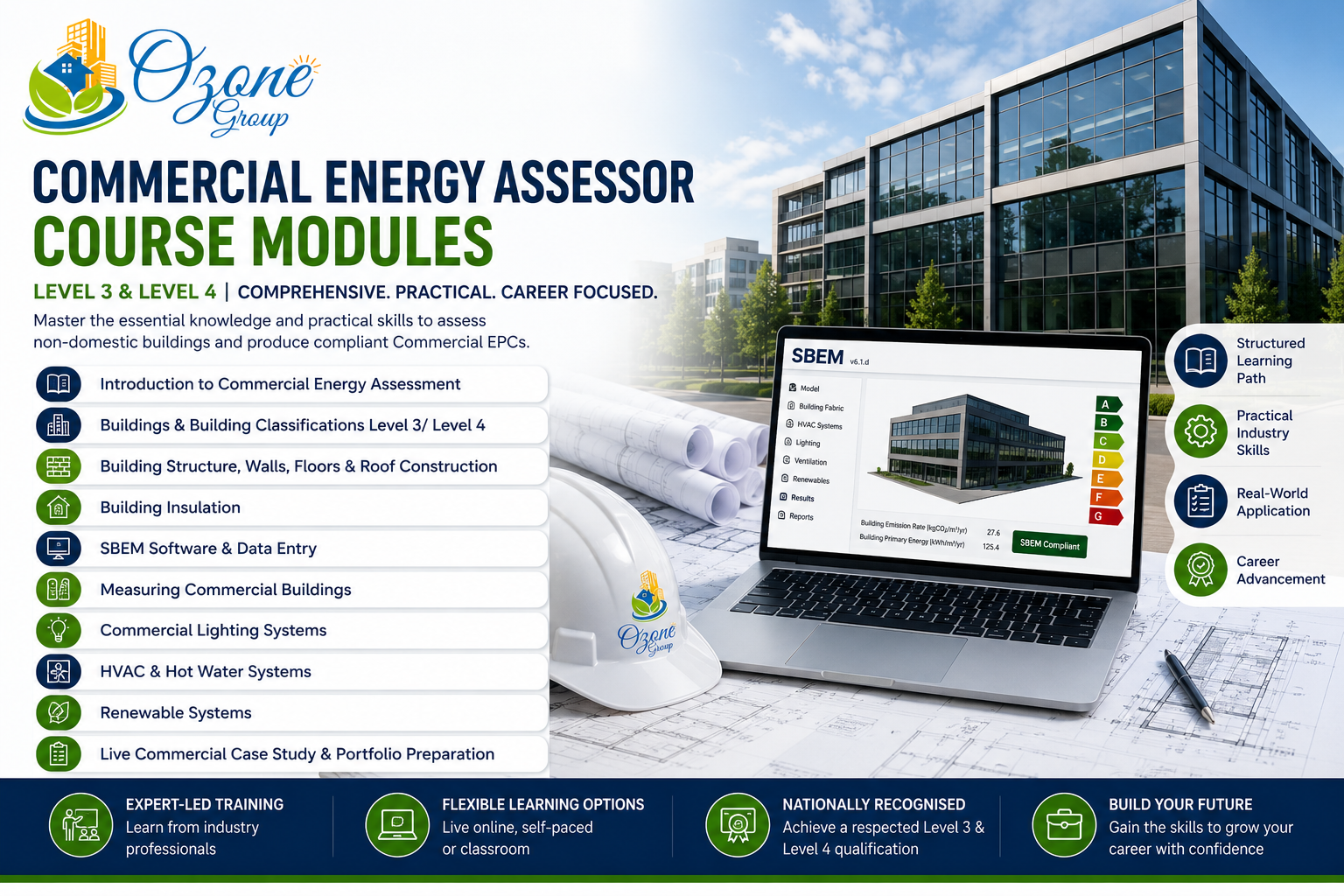
The following modules are included within the Level 3 & Level 4 Commercial Energy Assessor (NDEA) course. Each module has been carefully designed to build the technical knowledge and practical skills required to confidently carry out Commercial EPC assessments.
- ✓Introduction to Commercial Energy Assessment
- ✓Buildings & Building Classifications Level 3/ Level 4
- ✓Building Structure, Walls, Floors & Roof Construction
- ✓Building Insulation
- ✓SBEM Software & Data Entry
- ✓Measuring Commercial Buildings
- ✓Commercial Lighting Systems
- ✓HVAC & Hot Water Systems
- ✓Renewable Systems
- ✓Live Commercial Case Study & Portfolio Preparation
Introduction to Commercial Energy Assessment
This module introduces the role and responsibilities of a Commercial Energy Assessor (Non-Domestic Energy Assessor – NDEA). You'll gain an understanding of the Commercial EPC process, current legislation, professional standards, health and safety requirements, and the responsibilities involved in assessing commercial buildings.
Learning Outcomes
- Understand the role of a Commercial Energy Assessor.
- Explain the Commercial EPC process.
- Understand relevant legislation and industry standards.
- Apply safe working practices during commercial surveys.
Multi-Use Buildings & Building Classification
-
Commercial buildings vary significantly in design and use. This module explains how to identify different commercial property types, recognise mixed-use buildings and correctly classify buildings for assessment using approved methodologies.
Commercial buildings vary significantly in design and use. This module explains how to identify different commercial property types, recognise mixed-use buildings and correctly classify buildings for assessment using approved methodologies.
Learning Outcomes
- Identify different commercial property types.
- Recognise mixed-use developments.
- Select the correct assessment methodology.
- Understand building classification requirements.
Industry Context
-
Correct building classification is essential for producing accurate Commercial EPCs and complying with current government guidance.
Correct building classification is essential for producing accurate Commercial EPCs and complying with current government guidance.
Building Structure, Walls, Floors & Roof Construction
Develop a comprehensive understanding of commercial building construction, including structural elements, walls, floors and roofing systems. You'll learn how different construction methods affect thermal performance and influence Commercial EPC calculations.
Develop a comprehensive understanding of commercial building construction, including structural elements, walls, floors and roofing systems. You'll learn how different construction methods affect thermal performance and influence Commercial EPC calculations.
Learning Outcomes
- Identify common commercial construction methods.
- Assess building fabric accurately.
- Understand thermal performance characteristics.
- Record construction details correctly within SBEM.
Building Insulation
-
Explore the insulation materials commonly used within commercial buildings and understand how insulation contributes to improved energy efficiency, reduced heat loss and better Commercial EPC ratings.
Explore the insulation materials commonly used within commercial buildings and understand how insulation contributes to improved energy efficiency, reduced heat loss and better Commercial EPC ratings.
Learning Outcomes
- Identify insulation types.
- Understand thermal performance.
- Assess insulation during site surveys.
- Record insulation accurately within assessments.
SBEM Software & Data Entry
-
Gain practical experience using approved SBEM software to produce Commercial Energy Performance Certificates. You'll learn how to enter survey data accurately, review calculations and generate compliant Commercial EPC reports.
Gain practical experience using approved SBEM software to produce Commercial Energy Performance Certificates. You'll learn how to enter survey data accurately, review calculations and generate compliant Commercial EPC reports.
Learning Outcomes
- Navigate SBEM software confidently.
- Enter commercial building data accurately.
- Produce compliant Commercial EPCs.
- Validate assessment information before submission.
Industry Context
-
SBEM software is the industry-standard methodology used throughout the UK to calculate the energy performance of non-domestic buildings and produce compliant Commercial EPCs.
SBEM software is the industry-standard methodology used throughout the UK to calculate the energy performance of non-domestic buildings and produce compliant Commercial EPCs.
Measuring Commercial Buildings
Learn the practical surveying techniques required to accurately measure commercial buildings, calculate floor areas and collect the information required to complete Commercial EPC assessments.
Learn the practical surveying techniques required to accurately measure commercial buildings, calculate floor areas and collect the information required to complete Commercial EPC assessments.
Learning Outcomes
- Measure commercial buildings accurately.
- Calculate floor areas using industry standards.
- Record dimensions correctly.
- Collect survey evidence professionally.
Commercial Lighting Systems
-
Lighting plays a significant role in commercial energy performance. This module covers lighting technologies, controls, emergency lighting and energy-efficient systems commonly found within commercial properties.
Lighting plays a significant role in commercial energy performance. This module covers lighting technologies, controls, emergency lighting and energy-efficient systems commonly found within commercial properties.
Learning Outcomes
- Identify commercial lighting systems.
- Understand lighting controls and efficiency.
- Assess lighting performance.
- Record lighting data accurately within SBEM.
HVAC & Hot Water Systems
-
Develop an understanding of commercial heating, ventilation, air conditioning (HVAC) and domestic hot water systems. You'll learn how these building services influence energy performance and Commercial EPC calculations.
Develop an understanding of commercial heating, ventilation, air conditioning (HVAC) and domestic hot water systems. You'll learn how these building services influence energy performance and Commercial EPC calculations.
Learning Outcomes
- Identify HVAC systems.
- Understand commercial hot water production.
- Assess building services accurately.
- Record HVAC information correctly.
Renewable Energy Systems
-
Modern commercial buildings increasingly incorporate renewable and low-carbon technologies to improve energy efficiency and reduce carbon emissions. This module introduces the renewable energy systems commonly encountered during commercial building surveys and explains how they contribute to Commercial EPC calculations.
Modern commercial buildings increasingly incorporate renewable and low-carbon technologies to improve energy efficiency and reduce carbon emissions. This module introduces the renewable energy systems commonly encountered during commercial building surveys and explains how they contribute to Commercial EPC calculations.
Learning Outcomes
- Identify renewable energy technologies used within commercial buildings.
- Understand the operation of solar photovoltaic (PV), solar thermal, heat pumps and other renewable systems.
- Recognise how renewable technologies influence Commercial EPC ratings.
- Record renewable energy systems accurately within SBEM software.
Industry Context
-
As the UK continues its transition towards low-carbon buildings and Net Zero targets, Commercial Energy Assessors are increasingly expected to understand renewable technologies and their impact on building energy performance.
As the UK continues its transition towards low-carbon buildings and Net Zero targets, Commercial Energy Assessors are increasingly expected to understand renewable technologies and their impact on building energy performance.
Live Commercial Case Study & Portfolio Preparation
During the live training course, your tutor will complete a full commercial building assessment from start to finish. You'll observe how evidence is gathered, photographs are organised, building information is entered into SBEM software and the portfolio documentation is compiled for submission. You'll also see how supporting evidence is organised to meet the awarding body's portfolio requirements. This practical exercise provides valuable real-world experience before you begin your own assessments.
During the live training course, your tutor will complete a full commercial building assessment from start to finish. You'll observe how evidence is gathered, photographs are organised, building information is entered into SBEM software and the portfolio documentation is compiled for submission. You'll also see how supporting evidence is organised to meet the awarding body's portfolio requirements. This practical exercise provides valuable real-world experience before you begin your own assessments.
Learning Outcomes
- Observe a complete Commercial EPC assessment from survey through to submission.
- Understand the evidence required for a successful portfolio.
- Learn how to compile and organise portfolio documentation.
- Gain confidence before completing your own commercial building assessments.
Industry Context
Working through a complete commercial assessment with an experienced assessor provides valuable practical insight into the standards expected by the awarding body and the commercial energy assessment industry. Seeing the full process—from site survey and evidence collection to SBEM data entry and portfolio submission—helps bridge the gap between classroom learning and professional practice.
Working through a complete commercial assessment with an experienced assessor provides valuable practical insight into the standards expected by the awarding body and the commercial energy assessment industry. Seeing the full process—from site survey and evidence collection to SBEM data entry and portfolio submission—helps bridge the gap between classroom learning and professional practice.
Portfolio & Assessments
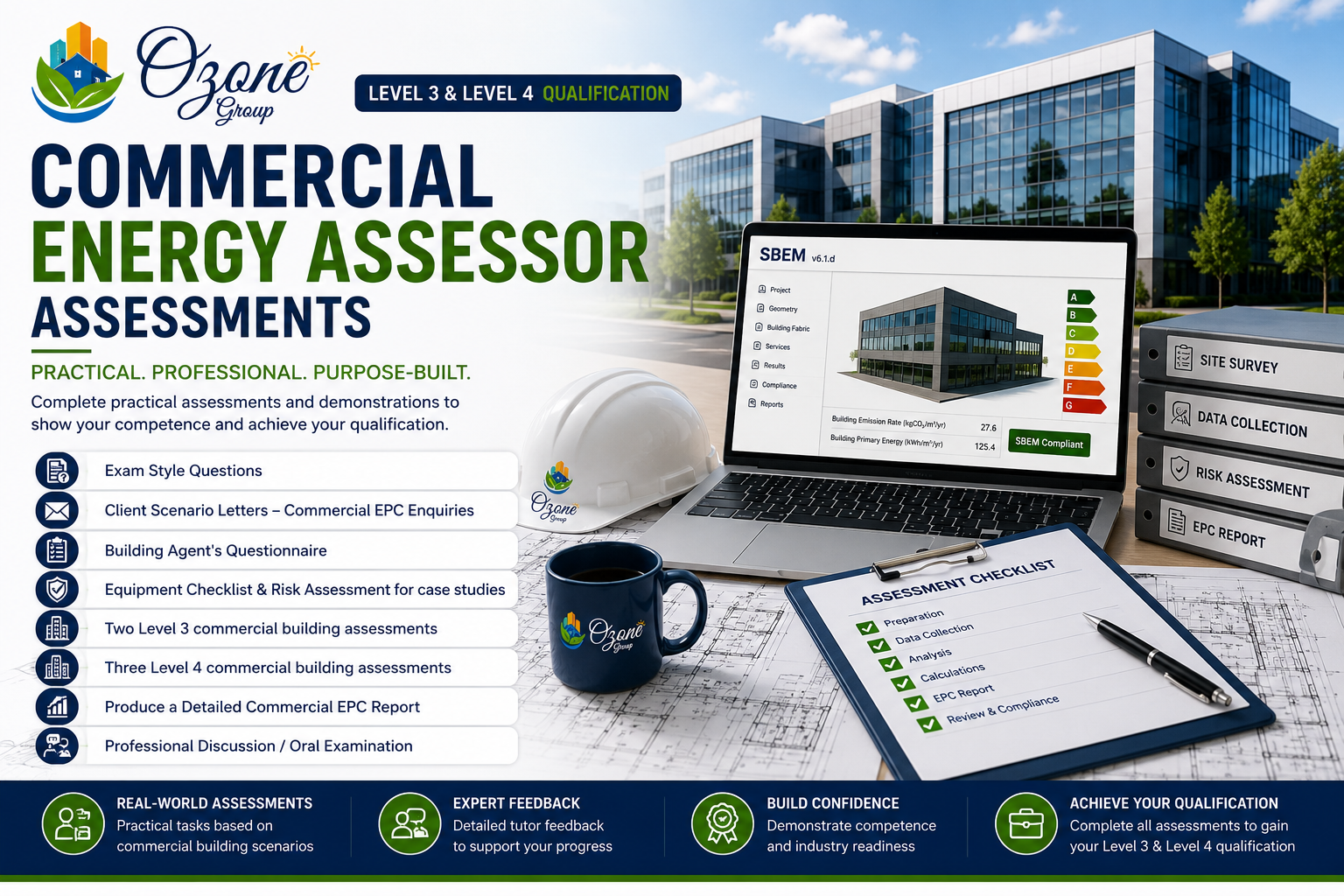
To successfully achieve the Level 3 & Level 4 Commercial Energy Assessor (Non-Domestic Energy Assessor – NDEA) qualification, you'll complete a portfolio of practical work together with professional assignments that demonstrate your competence in carrying out Commercial Energy Performance Certificate assessments.
The portfolio has been designed to develop both your technical knowledge and your practical surveying skills, ensuring you're fully prepared to work as a qualified Commercial Energy Assessor.
- Exam Style Questions
- Client Scenario Letters – Commercial EPC Enquiries
- Building Agent's Questionnaire
- Equipment Checklist & Risk Assessment for case studies
- Two Level 3 commercial building assessments
- Three Level 4 commercial building assessments
- Produce a Detailed Commercial EPC Report
- Professional Discussion / Oral Examination
Throughout your qualification, you'll receive ongoing guidance from your dedicated tutor, who will support you with every stage of your learning. From understanding course content and using SBEM software to completing commercial surveys, compiling your portfolio and preparing for your professional discussion, expert help is always available. Our goal is not only to help you achieve your qualification but also to ensure you have the confidence, practical skills and industry knowledge needed to begin your career as a qualified Commercial Energy Assessor (Non-Domestic Energy Assessor – NDEA).
Have Questions About the Course?
If you would like to learn more about the Level 3 Domestic Energy Assessor qualification, discuss the different training options, or find out which course is right for you, our friendly team is here to help. Whether you have questions about entry requirements, course delivery, assessments, funding or career opportunities, we'll be happy to provide honest advice and guide you through the enrolment process.
Contact Our Training Team